
What Can You Cook in an Oven-Safe Pan? A Guide by Oven Setting
A recipe gives you a temperature, and you can follow it. Change the cut, the thickness, or the vegetable, and you are back to searching for a new recipe — because you never learned what the number was for.
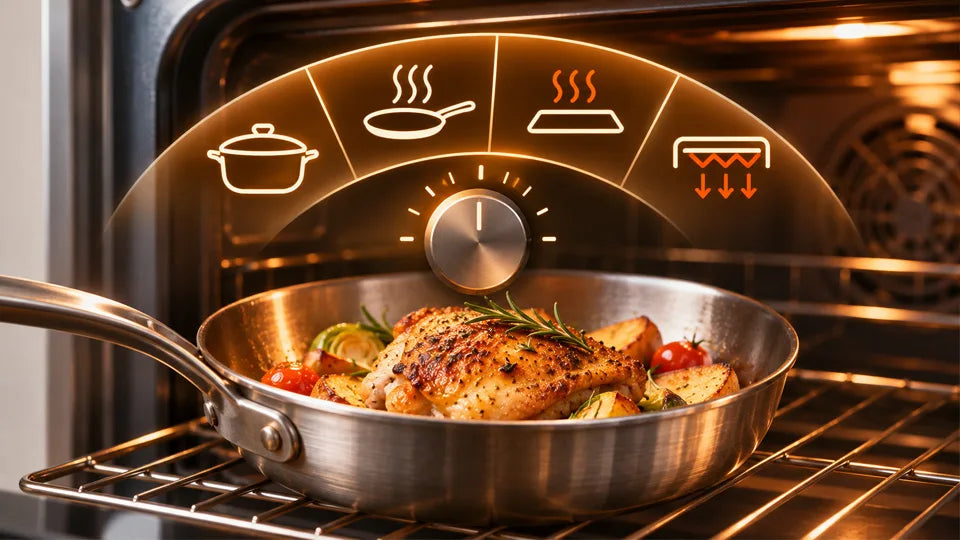
This article is about that. An oven does four distinct jobs, and each one has a setting that serves it. Once you know which job a dish needs, you can pick the number yourself instead of looking it up.
Ovens vary from one to the next, so treat every setting below as a starting point rather than a rule.
The Four Things an Oven Does

Low and covered: it converts
Set the oven low and leave the pan in there for a while, and you are not browning anything. You are converting it.
Collagen breaks down, flavors merge, and textures change from firm to yielding. This is the job behind braises, stews, and beans — anything where time rather than heat is doing the work.
The pan requirement here is simple: it has to take a lid. That makes this the one setting where a frying pan is usually the wrong choice, since a shallow open pan will dry out before the conversion is finished. A covered sauté pan or a Dutch oven is what this setting is built for.
For covered braises, a common starting range is 300–325°F. The goal is to maintain a gentle simmer in the cooking liquid rather than a vigorous boil. The upper limit matters more than the lower one — If the oven is too hot, the meat may shrink and lose moisture faster than the collagen softens, producing a drier or less evenly tender result.
Moderate: it finishes what the stove started
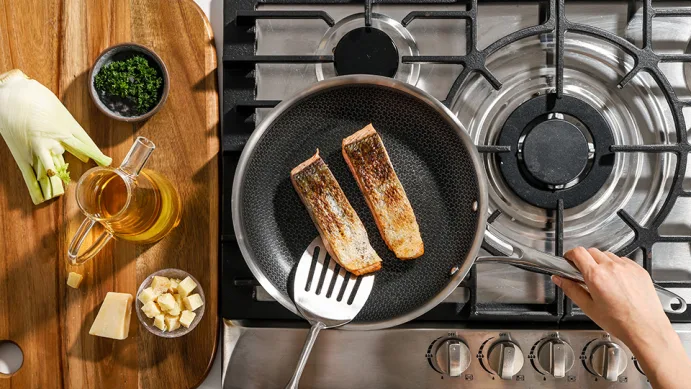
This is the setting that stovetop to oven actually refers to. You sear something on the burner, then move the whole pan into the oven to bring the center up to temperature without burning the outside.
Chicken thighs, pork chops, frittatas, whole fish, and most one-pan dinners live here. What they share is that the oven is doing the second half of a job the stove began.
For many sear-then-finish dishes, 375–400°F is a useful starting range. The best temperature still depends on the food's thickness, texture, and desired finish.
High: it works on the surface
Browning is driven by temperature; cooking through is driven by time. Turn the oven up and shorten the time, and the first one runs ahead of the second — the surface dries and browns faster than heat reaches the center.
That gap is why the foods that belong here are thin or flattened: pizza, potato wedges, cornbread, vegetables that need color, a spatchcocked bird. None of them need much time in the middle, so the surface can be pushed without the center falling behind.
High heat can brown the exterior of thick cuts before the center reaches the desired temperature. Larger cuts often benefit from adjusted cooking times, lower heat, or a two-stage cooking method.
Some recipes, particularly those using cast-iron skillets, call for preheating the pan in the oven. However, empty-pan preheating is not appropriate for every type of oven-safe cookware. Always follow the manufacturer's instructions. That is a harder thing to ask of a pan than cooking with food in it, because nothing is there to absorb the heat.
A common starting point is around 450°F. If you want to go higher, that is what the pan's rated maximum is for — DELUXE hybrid cookware is rated to 500°F for up to one hour, and this is the product limit rather than a recommended everyday cooking temperature.
Broil: the same dial does something different
Broil is not simply a hotter bake, and treating it as one is how pans get damaged.
Bake heats the whole cavity, so the pan and the food warm at roughly the same rate. Broil puts a heating element above the food and radiates straight down onto whatever is exposed.
That means the parts of the pan with nothing covering them — the rim, the handle, the helper handle — take far more heat than the base does. Which is why "safe to 500°F in the oven" and "safe under the broiler" are two separate questions.
Before broiling, confirm that the manufacturer specifically approves the pan and all of its components for broiler use. An oven-temperature rating alone does not necessarily establish broiler compatibility.
Moving the Pan to the Oven

The move happens on appearance, not on the clock
You move the pan when the surface is ready, and the surface tells you in three ways: the food slides when pushed, it releases on its own, and a browned crust has formed where it meets the pan.
A steak, a chicken thigh, and a fillet of fish all reach that point by the same sign and at completely different times. The clock cannot help you here, because pan thickness, burner strength, and the temperature of the food going in all shift the timing.
Watch the food, not the timer.
The pan should already be hot
The pan needs to be fully heated on the burner before it goes into the oven.
A hot pan entering a hot oven puts the food straight into cooking conditions. A lukewarm one spends the first several minutes of oven time just catching up, which is oven time the food is spending without anything useful happening to it.
Leave space around the food
An oven cooks by surrounding the food with heat. Fill the pan edge to edge and the air cannot circulate around it, so the food steams in its own moisture instead of roasting.
One layer, with gaps between the pieces. If it does not fit, use two pans or cook in batches — crowding is a common reason an oven-finish step produces a pale, wet result.
Stovetop to Oven: Adapting a Recipe
What converts cleanly
The test is whether the food needs a person standing over it.
If a dish requires constant attention — stirring, flipping, tossing — it belongs on the stove. If it needs heat applied steadily for a stretch of time and nothing else, it belongs in the oven.
Three groups pass that test reliably.
- Proteins that get seared first and finished second: thick steaks, chicken thighs, pork chops, whole fish.
- Anything that sets by gentle, even heat: frittatas, shakshuka, baked pasta.
- And anything that needs color on more than one side at once: roast vegetables, chicken with skin, potatoes.
What Fails in the Oven
Three groups fail it, for different reasons.
- Anything that needs tossing. Fried rice, noodles, a stir-fry. Move these to the oven and you have not made them easier, you have turned them into a steam.
- Anything already breaded or battered. A fried crust moved to the oven does not stay crisp — the meat keeps releasing moisture as it finishes, and that moisture now escapes through the crust instead of away from it. Wet batters fail for a different reason: they set when water flashes against hot oil, which oven air never delivers.
- A braise you want to reduce. Braises belong in the oven — that is what the low, covered setting is for. What does not survive the move is a dish whose point is reducing on an open burner. Without a lid, the braise top dries before the middle liquid thickens; with a lid, braise retains moisture and reduces slowly.

What to change when you adapt
Go from covered to uncovered. A dish that simmered under a lid on the stove usually wants to finish open in the oven, so the surface can dry and color. A covered sauté pan makes that switch a matter of taking the lid off rather than moving the food to a different vessel.
Look more often than the recipe suggests. You cannot see the bottom of the pan in an oven, and every oven runs a little differently from the next. Check on color and edges rather than elapsed time, especially the first time you make the conversion.
When a Pan Is the Wrong Choice
A pan that can go in the oven is not a pan for everything, and knowing where it stops is more useful than pretending it does not.
- A whole chicken, a rack of ribs, a whole tenderloin. These want a roasting pan. They need room around them for air to move, the pan limits the efficiency.
- A stew that will not fit. Long, slow cooking in a covered pan is the low setting's whole point, and a deep sauté pan handles it. What it cannot do is hold a stew whose total volume exceeds the pan. That is a question of capacity, not of what the pan is made for — and once the answer is a bigger vessel, a Dutch oven is the usual one.

Conclusion
Four jobs, and you will use one of them far more than the other three.
The moderate setting covers almost everything that starts on a burner and ends in an oven. Low and covered is that same idea stretched longer; high and short is the same idea compressed; broil is a different method wearing the same dial.
When you are not sure where to start, start in the middle and adjust by what you see. The food will tell you if you got it right.
Frequently Asked Questions
Does the rack position matter?
Yes, and it is the setting most people never adjust. The middle of the oven is the closest thing to even heat, which suits anything that needs to cook through. Move the pan up when you want the top to brown, and down when you want the base to brown without drying the surface. For broiling, the pan goes near the top element — which is exactly why the parts sticking up are the ones to worry about. Follow the appliance manufacturer’s instructions for baking, roasting, and broiling.
Should I use convection or the regular bake setting?
Convection moves air with a fan, so it transfers heat faster and dries the surface more. For a covered braise it makes little difference. For anything you want browned and crisp, it helps — and it also means the food will get there sooner than a conventional recipe assumes.
Can I put cold food straight into a hot pan in the oven?
You can, but the pan will lose heat the moment the cold food touches it, and the first few minutes go into recovering rather than cooking. Letting meat sit out briefly, or at least not taking it straight from the fridge, gets more out of the same oven setting.
Can I cover the pan with foil?
Foil traps steam, so it slows browning and keeps the surface moist. That is useful for the first part of a long cook and counterproductive for the last part. If you want a crisp top, take it off before the end rather than after.

Leave a comment
This site is protected by hCaptcha and the hCaptcha Privacy Policy and Terms of Service apply.