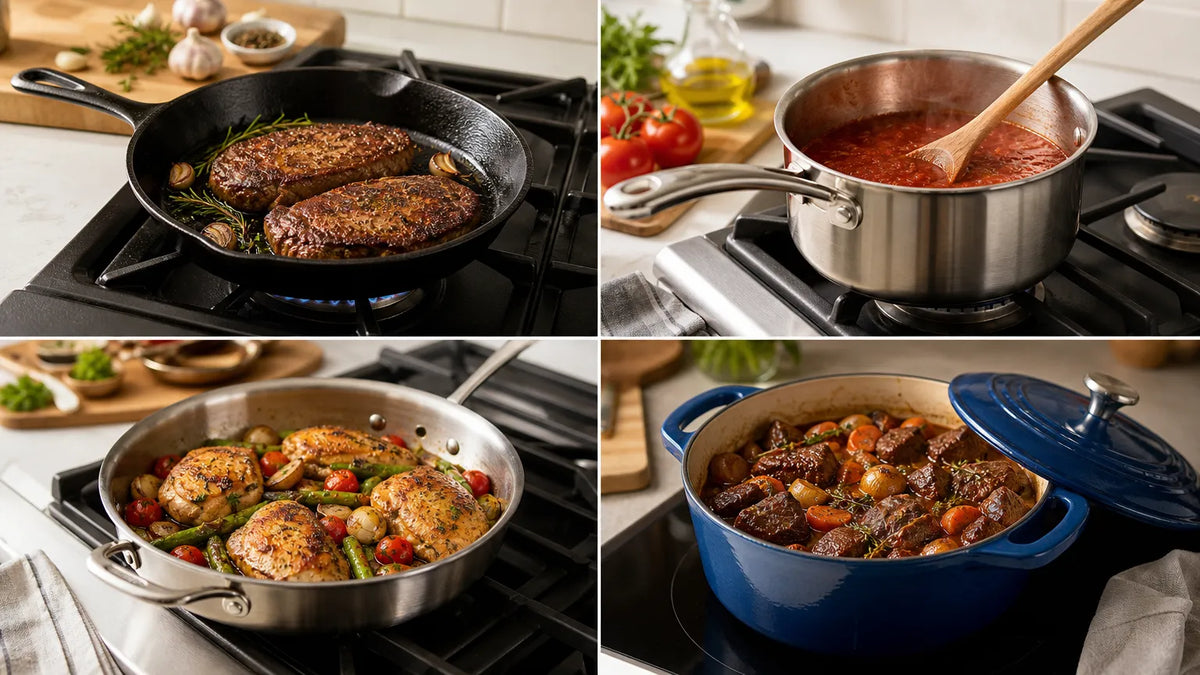
Types of Pots and Pans: A Practical Guide to Building a Useful Set
The most useful types of pots and pans match how you cook. A skillet, saucepan, sauté pan, and Dutch oven can cover frying, simmering, sauce making, braising, and one-pan meals.
Building a set is less about collecting every shape and more about choosing distinct functions. Geometry affects evaporation and utensil access, while construction influences heat response, food release, weight, and care.
How Does Cookware Shape Affect Cooking?
Cookware shape changes how much food touches the base, how quickly moisture escapes, and how easily a utensil moves. Two vessels made from similar materials can therefore suit different tasks.
| Shape Feature | Main Effect | Useful For |
|---|---|---|
| Wide surface | Encourages evaporation | Reductions and browning |
| Tall walls | Add liquid capacity | Soups and boiling |
| Curved sides | Improve utensil access | Sauces and pouring |
Wide Surfaces Increase Evaporation
A broad surface can speed evaporation and gives food room to release moisture. Results still depend on batch size and burner coverage.
Tall Walls Retain More Moisture
Tall walls provide capacity for liquids and expanding foods while helping contain splashes. A fitted lid retains more moisture by trapping vapor.
Curved Sides Improve Stirring and Pouring
Rounded transitions give whisks and spatulas fewer corners to miss. They aid stirring and pouring but reduce capacity compared with straight walls at a similar rim diameter.

What Are the Main Types of Frying Pans?
Frying-pan families differ mainly in wall shape and usable surface. A skillet favors access, a sauté pan contains liquids, and a griddle maximizes flat cooking space.
| Pan Type | Wall Profile | Primary Strength |
|---|---|---|
| Skillet | Low and sloped | Turning and tossing |
| Sauté pan | Taller and straight | Liquid containment |
| Griddle | Very low edge | Broad flat contact |
Skillets Handle General Frying Tasks
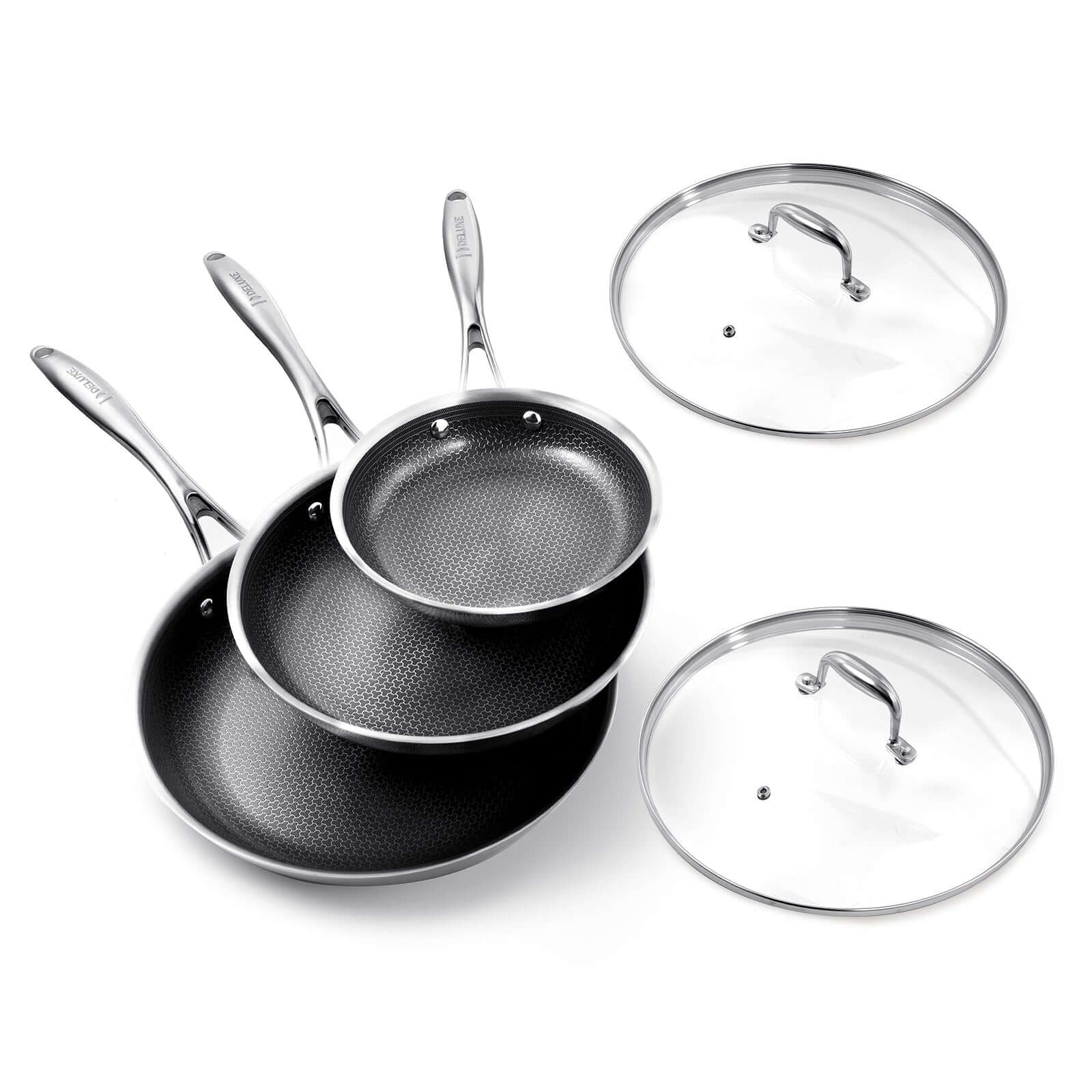
A skillet's low, sloped sides make food easy to turn and let steam escape. In American usage, “skillet” and “frying pan” are often interchangeable.
Sauté Pans Hold Liquids More Securely
A sauté pan pairs a broad base with taller vertical walls. The Utah State cookware guide distinguishes this profile from a skillet's flared sides. It suits shallow frying, braising, sauces, and one-pot pasta.
Griddles Provide a Broad Flat Surface
A griddle provides open contact for pancakes, sandwiches, eggs, and several small portions. Unlike a ridged grill pan, its flat surface creates continuous contact browning.

What Are the Main Types of Cooking Pots?
Cooking pots use taller walls to manage liquid and volume. The Institute of Child Nutrition equipment guide lists saucepans, stockpots, Dutch ovens, and sauté pans among common vessel types, although home kitchens rarely need every option.
| Pot Type | Typical Handle Style | Best Starting Role |
|---|---|---|
| Saucepan | One long handle | Small liquid recipes |
| Stockpot | Two side handles | High-volume boiling |
| Dutch oven | Two side handles and lid | Braising and slow cooking |
Saucepans Handle Smaller Liquid Recipes
A saucepan's long handle and moderate capacity suit grains, eggs, sauces, soup, and side dishes. Balance becomes important when the vessel is full.
Stockpots Provide High-Volume Capacity
A stockpot's tall body and side handles suit broth, pasta water, and batch cooking. Leave space for safe lifting.
Dutch Ovens Support Braising and Roasting
A Dutch oven uses substantial walls and a close-fitting lid for braising and stews. It can move into the oven only when each component is suitably rated.

Which Pan Suits Each Cooking Method?
Match the food's moisture and required access to the vessel's base, walls, and lid. One pan can cover several techniques, but its geometry usually reveals its strongest role.
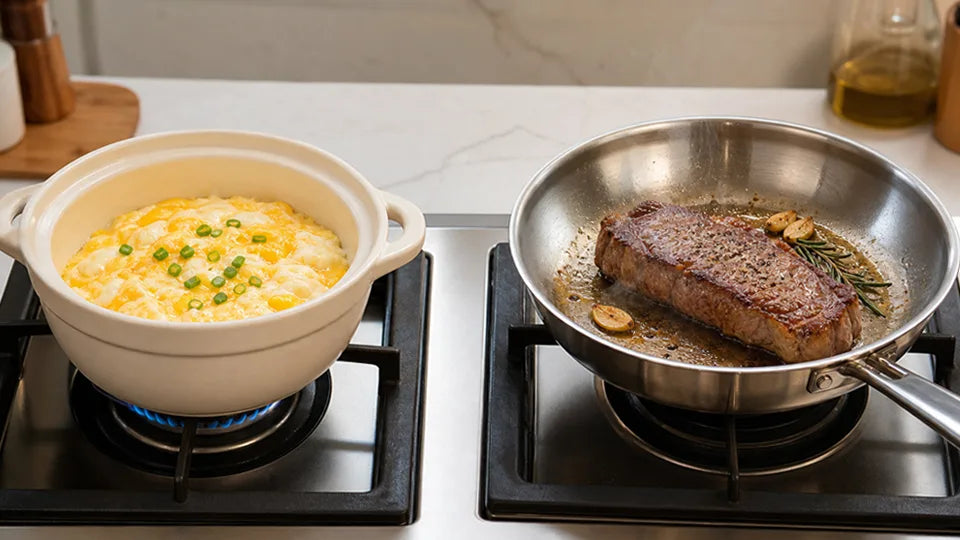
Skillets Suit Searing and Shallow Frying
A skillet lets steam disperse and makes food easy to turn. Browning depends on a dry surface, spacing, and controlled preheating. Shallow frying also requires enough wall height for oil and displaced food.
Saucepans Suit Simmering and Sauce Making
A saucepan concentrates a modest liquid volume over a smaller base. Bare stainless steel is not naturally nonstick; stainless pots and pans require suitable preheating, oil for frying, and more technique to reduce sticking.
Dutch Ovens Suit Braising and Slow Cooking
A Dutch oven supports browning followed by covered, gentle cooking. Braising uses controlled liquid rather than full submersion, while a lighter stockpot may be easier for high-volume boiling.
How Should You Compare Cookware Materials?
Compare the complete construction rather than only the visible surface. Conductive cores, magnetic bases, coatings, thickness, handles, and lids can all affect performance and maintenance.

Compare Heat Response and Distribution
Aluminum conducts heat more readily than stainless steel, while stainless steel contributes strength and corrosion resistance. Many stainless vessels therefore use an aluminum or copper layer to improve distribution, as noted by McGill University's cookware overview.
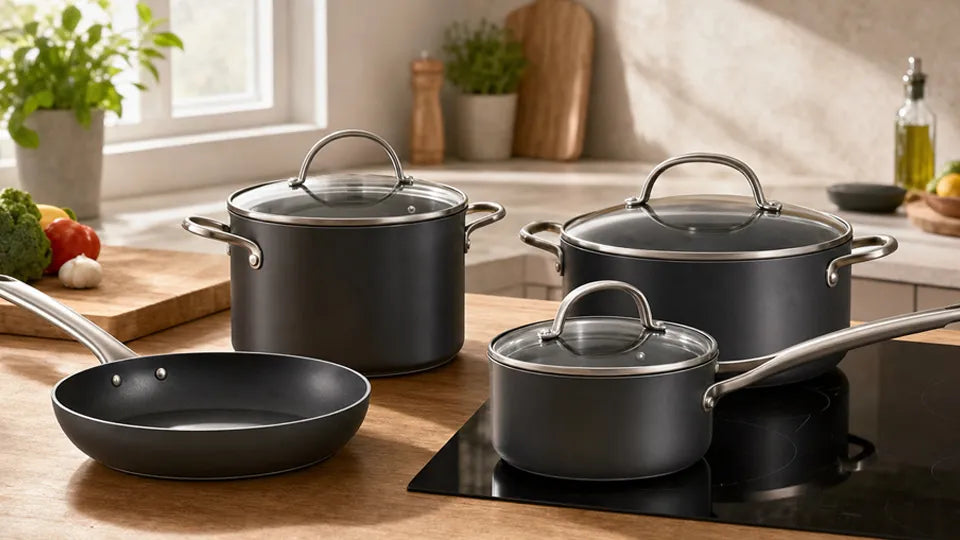
Induction pots and pans need a base that interacts with the cooktop's magnetic field. Compatibility must be confirmed for each piece; a stainless appearance alone does not prove it. For gas cooking, stable bases, suitable diameter, and flame control matter more than claims about one universally best material.
Compare Food Release and Browning
The best nonstick pots and pans depend on the food and expected care. Nonstick surfaces can simplify delicate foods and cleanup, while uncoated stainless steel can support fond development when properly preheated and oiled.
Compare Weight, Care, and Durability
Heavier cookware may feel stable but becomes harder to lift when full. Coatings, exposed metal, handles, and lids also require model-specific care. Shoppers may see hard anodised pots and pans; the usual U.S. spelling is “hard-anodized.” The term describes treated aluminum, not automatic nonstick, induction, or dishwasher compatibility.
How Can You Avoid Duplicating Functions?
A useful set gives each piece a primary job and credible secondary roles. Reviewing cooking habits and existing capacities before buying prevents several pans from competing for the same task.
- List the cooking methods used every week.
- Record the shapes and capacities already owned.
- Identify one recurring limitation or missing function.
- Add the piece that closes that specific gap.
Prioritize Frequently Used Cooking Methods
Start with recurring meals. A cook who fries eggs, reheats soup, makes one-pan dinners, and braises may benefit most from a skillet, saucepan, sauté pan, and Dutch oven. Cooktop type belongs in this review because every induction piece needs verified magnetic compatibility.
The best pots and pans for gas stove cooking still require stable bases, comfortable handles, and diameters suited to the burners. No single material or set is automatically best for every gas kitchen.
Choose Multipurpose Shapes Before Specialty Pans
Multipurpose vessels usually deserve space before single-food pans. A skillet covers everyday frying, a sauté pan manages liquid-rich meals, and a Dutch oven overlaps with some stockpot duties.
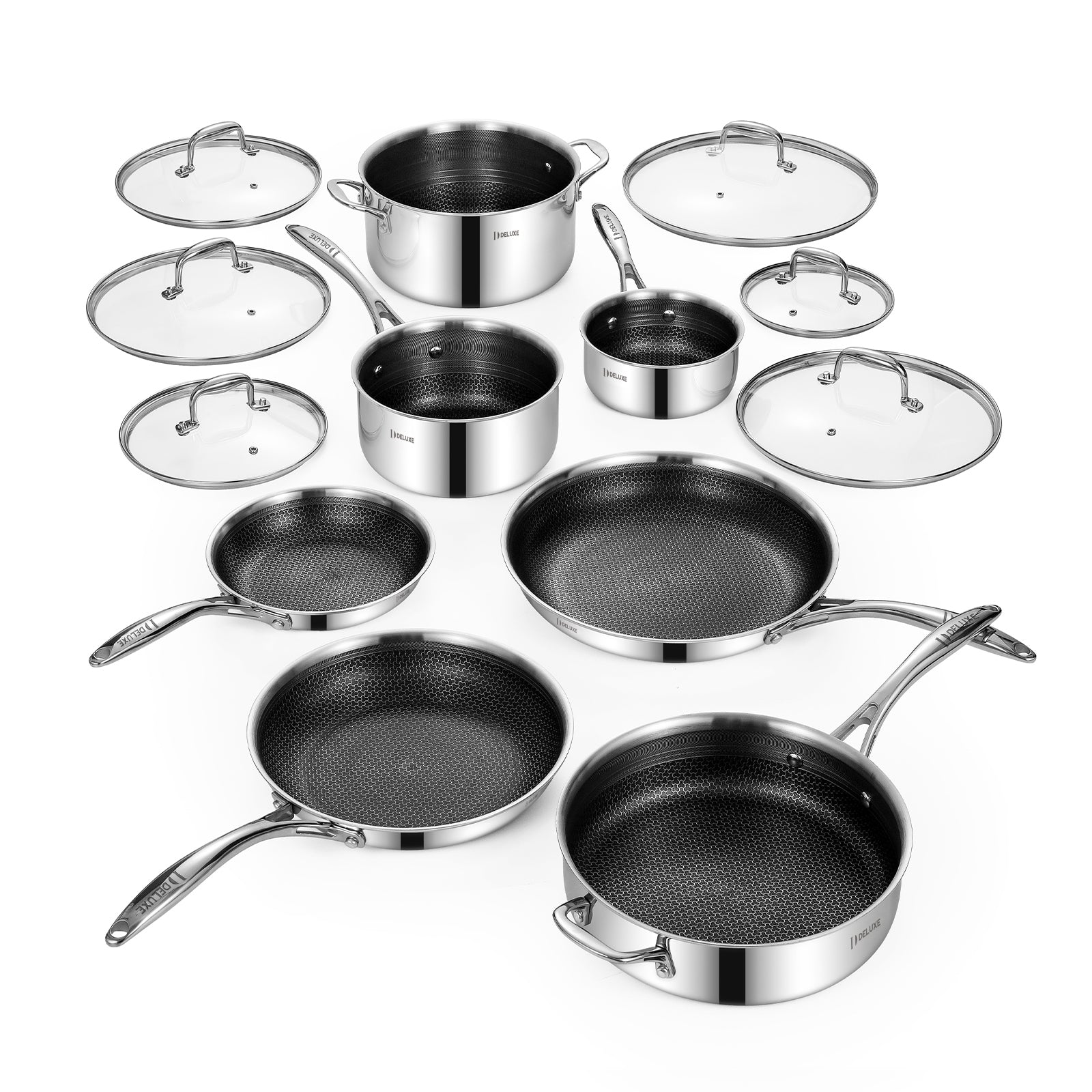
Our 13-piece hybrid cookware set shows how frying pans, saucepans, a sauté pan, a Dutch oven, and matching lids can form one coordinated system. Its verified hybrid construction means it is neither pure stainless steel nor pure ceramic cookware.

Compare Capacity Before Adding Another Piece
Capacity should create meaningful separation. Two nearly identical saucepans may add less value than a larger vessel for different batches. Record each piece's capacity, base diameter, wall shape, lid, and common use, then add cookware only when it solves a recurring limitation.
Explore the Right Types of Pots and Pans
Build from the meals you prepare, then compare shape, capacity, construction, and care. Our cookware set collection helps you review coordinated options after identifying the functions your kitchen needs. Explore the right types of pots and pans today, and choose pieces that expand your cooking range instead of repeating tools already in your cabinet.
Common Questions About Pots and Pans for Different Cooking Needs
Q1. How Many Pots and Pans Does a Small Kitchen Need?
Many small kitchens can begin with three or four complementary pieces: a skillet, a saucepan, a sauté pan, and, when covered slow cooking is common, a Dutch oven. The ideal number depends more on recurring meals and storage space than on a fixed set size.
Q2. When Is a Saucier Better Than a Saucepan?
A saucier is often better when frequent whisking is central to the recipe. Its rounded interior reduces corners where custard or gravy can collect, while its wider opening encourages evaporation. A straight-sided saucepan remains useful when liquid containment matters more.
Q3. Are Induction Pots and Pans Suitable for Other Cooktops?
Most induction-compatible cookware can also work on gas and conventional electric cooktops, provided the manufacturer confirms compatibility. Induction cooking specifically requires a magnetic base, but that feature does not prevent the vessel from working with other suitable heat sources.
Q4. Should Every Pot and Pan in a Set Include a Lid?
Not necessarily. Lids are most useful for saucepans, sauté pans, stockpots, and Dutch ovens because these vessels commonly handle simmering or moisture retention. Frying pans may be sold with or without lids, so shoppers should check the exact set contents instead of assuming every piece is covered.
Q5. Which Specialty Pans Can Most Kitchens Skip?
It depends on cooking habits, but dedicated egg, pancake, crepe, or grill-mark pans are often optional when a skillet or flat griddle performs the task. A specialty pan becomes worthwhile when its distinct function is used often enough to justify separate storage.