
Is Hybrid Cookware Dishwasher Safe? What Actually Happens Over Time
Read the product page and you will find the words dishwasher safe. Read the care sheet in the box and you will often find the same brand suggesting you wash the pan by hand. Both statements come from the same company, about the same pan, and neither is a mistake.
They answer different questions. Dishwasher safe tells you what a cycle will not do to the pan. Hand washing is advice about how quickly the surface changes across the years you own it. This article separates the two, and then looks at what a dishwasher is actually doing to a coated pan while you are not watching.
Why Both Instructions Are Correct
Both instructions are correct because they address different aspects of cookware care.
A hybrid pan labeled dishwasher safe is designed to tolerate normal dishwasher use without immediate loss of function.
A pan that comes out looking unchanged has no obvious visible damage, although appearance alone cannot confirm its long-term condition.
The recommendation to hand wash is about something else: the surface you cook on.
Heat, detergent, water movement, and mineral deposits affect a coating gradually rather than suddenly. One cycle does not break the pan. Repeated cycles move the coating toward the end of its useful life sooner than hand washing would.
Dishwasher safe answers whether the pan survives. Hand washing answers how long it stays at its best. Most care labels only answer the first.
What "Dishwasher Safe" Actually Means
It is the maker's own statement, not a certification, and what it covers is narrower than most people assume.
On cookware sold in the US, the phrase has no single fixed test behind it. What it conventionally promises:
- The item will not be visibly damaged by a normal cycle
- It will not come apart
- It will keep doing its job
What it does not promise is anything about the surface over time. Coating life, gloss, and food release sit outside what the label covers.
A pan can honestly call itself dishwasher safe and still lose its nonstick quality noticeably earlier than a hand-washed twin.
This is why the two instructions coexist on the same box without contradiction. One sets a durability floor. The other is a preference about where you land between convenience and surface condition. Read them that way and the advice stops sounding evasive.
What Actually Happens Over Time
A dishwasher cycle is a mild environment. A complete dishwasher program may run for an hour or longer, although the pan is not exposed to peak washing conditions for the entire cycle. None of that is enough to damage a sound coating in one pass, which is why a pan comes out looking exactly as it went in.
The change is cumulative, and it arrives in stages.

The First Wash: Nothing Looks Different
This stage is real and worth taking seriously. If a single cycle visibly harmed the pan, the label would be a lie rather than a simplification. Anything you notice after one wash is almost certainly water spots or a dried film, both of which come off with a warm hand wash.
The Early Washes: What Changes First
The first honest signal is dulling. The surface loses the faint sheen it had when new, and water stops beading the way it did. Food release is still fine, but it becomes slightly less automatic — you find yourself reaching for a little more oil without deciding to.
Nothing here reads as damage. That is exactly why it goes unnoticed. The coating has not failed; the trend has started.
Over Time: Where It Starts to Show
Appearance changes before performance, and performance does not come back.
By the time the change is obvious, several things have usually happened together:
- Release has degraded enough that eggs need fat
- Residue has settled into the grooves of the etched surface and no longer rinses away
- Rivets and rims carry a haze or brown film that takes real effort to lift
There is no product that reverses coating wear. Only care that slows it.
What a Cycle Is Actually Doing
Five things act on the pan at once.
- Sustained heat is the first. Dishwasher washing and drying run hotter than a sink full of tap water, and repeated exposure weakens the bond between the topcoat and the layer beneath it.
- Alkaline detergent is the second. Dishwasher detergent is built to attack baked-on grease, which makes it a stronger chemical environment than dish soap. Over many cycles it strips the surface of the properties that make food release.
- Water movement and contact are the third. The spray itself is harmless. The real risk is physical: cutlery and small items shift in the basket and knock against the pan, and a single nick becomes a permanent sticking point.
- Residue film is the fourth. Mineral deposits or incompletely rinsed detergent can collect around rivets and rims and leave spots or haze.
- Mineral scale is the fifth, and it is the one that varies most by household. In hard-water areas, the same heat that dries the pan also bakes minerals onto it, and that film dulls the surface and interferes with release.
Together they explain the whole pattern: one cycle looks fine, and frequent cycles stack.
Why Hybrid Pans Are a Special Case
A hybrid pan is not simply a nonstick pan with a different label. Its construction changes what a dishwasher has to work on.

The Etched Surface Has Grooves
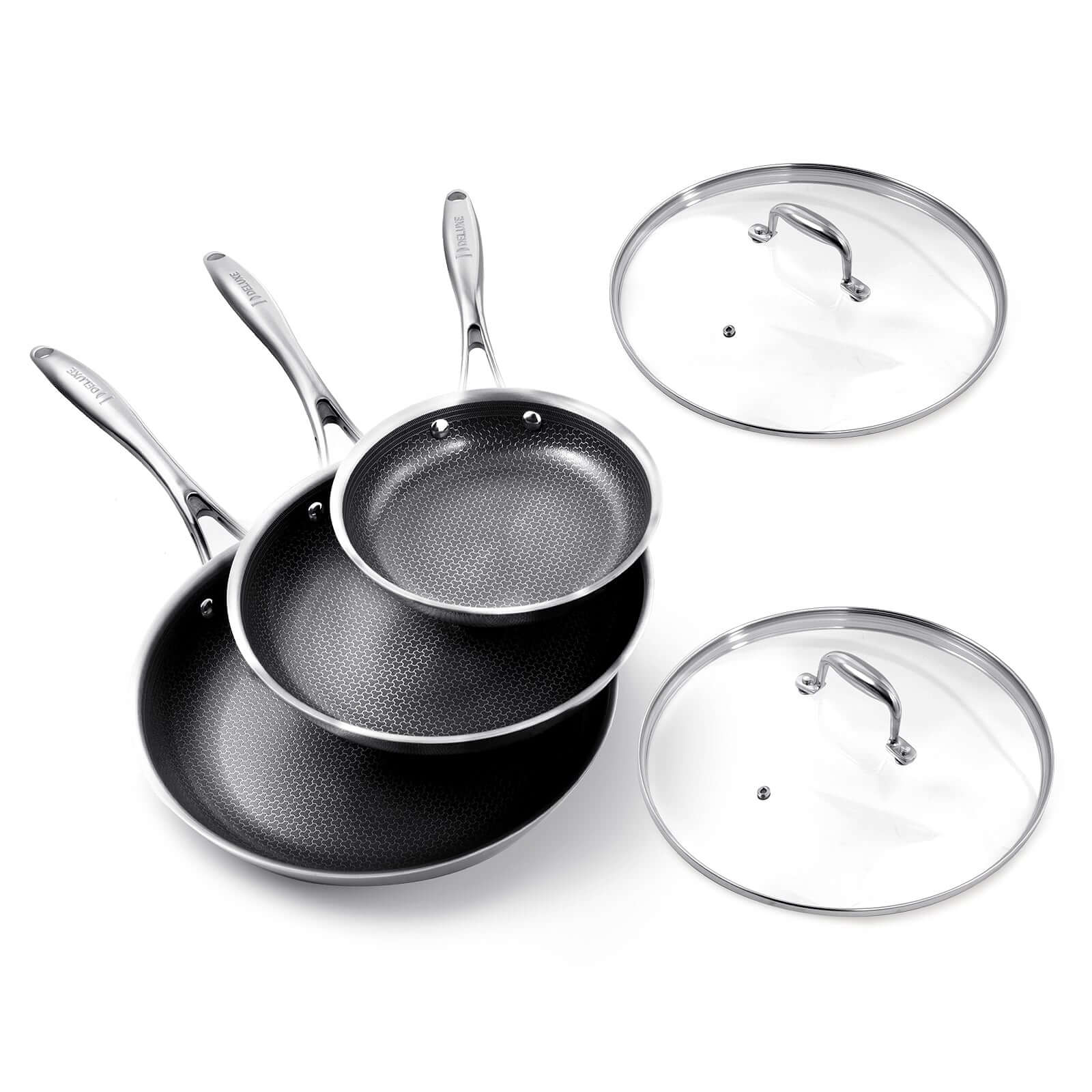
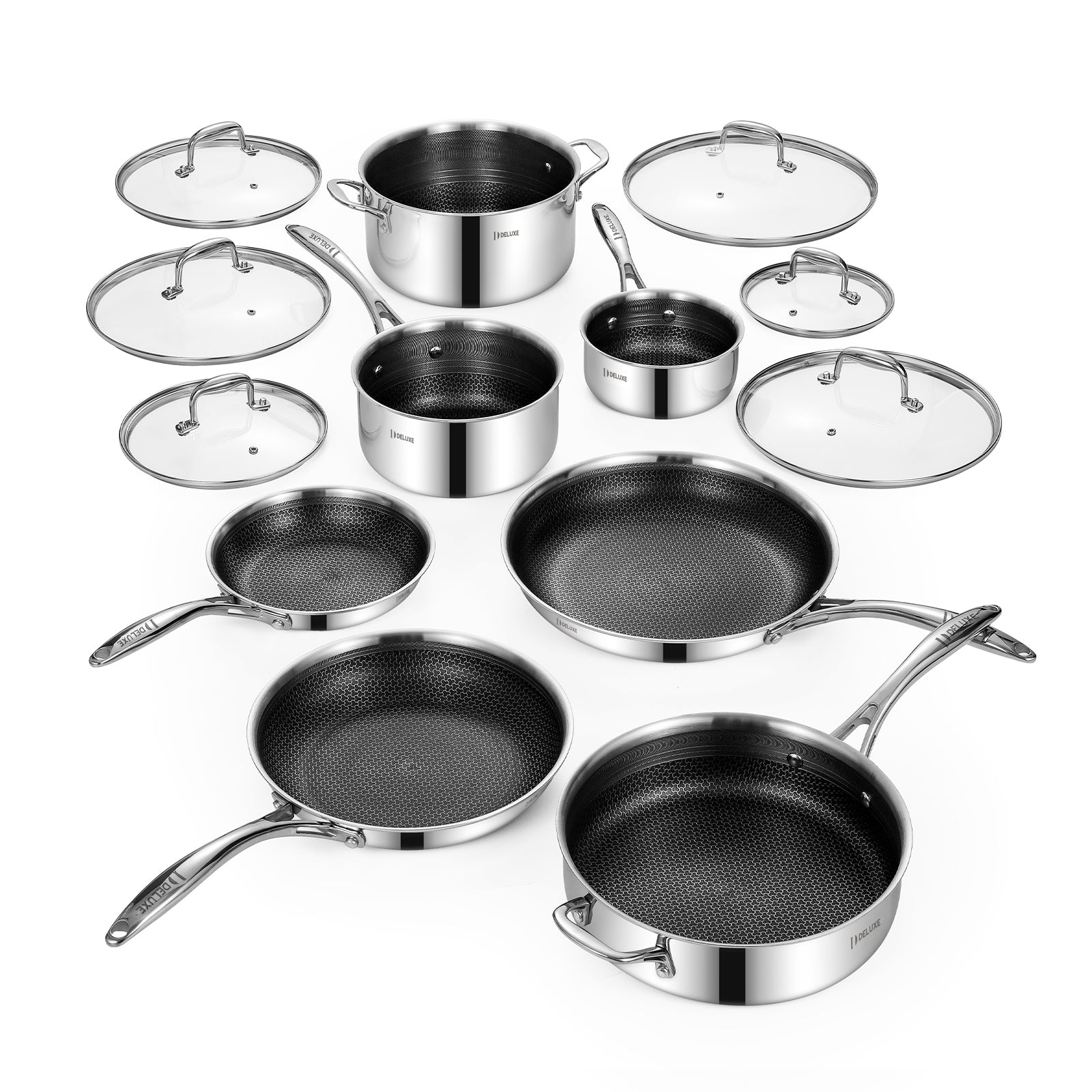
The laser-etched honeycomb surface that defines hybrid cookware is a raised metal mesh sitting above recessed coating. That geometry is what makes the pan resistant to utensils and gives it its particular feel under a spatula.
It also gives residue somewhere to sit. A flat coating sheds water and detergent evenly. A textured one holds both in the recesses, and in a dishwasher those recesses are where film and scale collect first. This is a structural point, not a coating point, and it applies to the category rather than to any one product.
The Handle and the Rivets
A stay-cool handle works by keeping the interior of the handle isolated from the heat of the pan. That isolation depends on the handle staying sealed. Rivets, meanwhile, create small gaps where water sits after a cycle and where residue accumulates over many of them.
Neither is a reason to avoid the dishwasher. Both are reasons to take the pan out and dry it rather than leaving it in the machine overnight.
The Base and the Walls
The layered base and the magnetic outer layer face the most direct exposure to hot, alkaline water. What shows up there is typically a change in appearance rather than performance. This is one of the few places where the honest answer is simply that it does not matter much — a pan with a dulled exterior still cooks the same.
Does the Coating Type Change the Answer?
Partly, and in a way that is usually skipped.
Two pans can both be called nonstick and respond to a dishwasher differently, because the two common coating families fail for different reasons.

Ceramic coatings
Ceramic nonstick coatings are inorganic and hard, and they tolerate heat well. What they lack is flexibility.
Their main vulnerability in a dishwasher is mechanical rather than chemical: impact and shifting load can produce micro-cracks in a surface that does not flex to absorb them.
PTFE coatings
PTFE-based coatings are softer and tougher. They shrug off knocks that would mark a ceramic surface.
Their weak point sits lower in the stack — the resin system bonding the coating to the metal is what sustained heat and strong alkalinity act on.
What that means in practice
"Will the dishwasher hurt this pan" has a different mechanism behind it depending on the coating, even though the final advice lands in roughly the same place.
- A ceramic pan is more likely to be marked by what hits it
- A PTFE pan is more likely to be affected by what washes over it
Knowing which one you own tells you which habit to fix first.
When the Dishwasher Is Fine, and When It Isn't
Rather than one verdict, 4 conditions.
Reasonable default — the pan goes in once or twice a week, nothing is burnt on, and you take it out and dry it afterward.
Better to hand wash — you live with hard water, the pan has already lost some release, or the pan has already been exposed to excessive heat or shows reduced food release.
Clearly hand wash — the pan shows visible scratches or patchy wear. The coating has less margin, and a gentler routine buys real time.
A judgment call — a pan used daily for searing is not the same object as one used for eggs, even if they are the same model.

If You Do Use the Dishwasher
Six things, all practical.
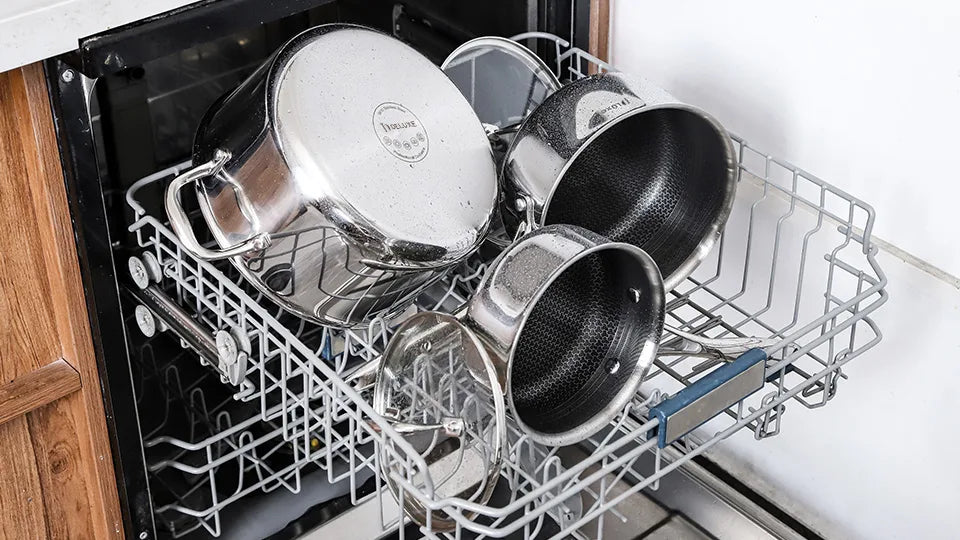
- Keep the pan away from loose cutlery and heavy items that can strike it
- Load it so water drains rather than pools
- Use a standard or eco cycle instead of sanitize and heavy-dry
- Take it out at the end and dry it by hand
- Avoid direct contact with bare aluminum items, which may discolor or leave marks on nearby surfaces during washing.
- Treat frequency as the variable you control, not whether it can go in at all
The useful question is not whether the pan can go in the dishwasher, but how often you want it to. Every model in our hybrid line is built to handle both routines, which is why the care sheet recommends the gentler one rather than requiring it.
Hand Washing, in Three Steps
Let the pan cool before it meets water. Pouring cold water into a hot pan is the most common way to stress the bond between coating and body, and it costs nothing to avoid.
Use a soft sponge, warm water, and a small amount of dish soap. No specialty cleaner is needed, and pressure is not the tool that works here.
Soak, don't scrape. Ten minutes of warm water does more than any abrasive and leaves the surface intact. A covered sauté pan makes this easy, since the lid keeps the water warm while the residue softens.
Conclusion
A hybrid pan will survive the dishwasher. That was never really in question, and the label is not dishonest for saying so.
What the label does not tell you is that convenience has a price, and the price is paid in surface condition rather than in function. Hand washing buys a longer stretch of the surface feeling the way it did when you unboxed it. The dishwasher buys back the minutes you would have spent at the sink.
Both are defensible. The mistake is believing you are getting one without giving up the other.
Frequently Asked Questions
Can you put hybrid pans in the dishwasher?
Yes, if the specific hybrid pan is labeled dishwasher safe. Whether you should depends on how often — occasional cycles are a reasonable convenience, and a steady habit of daily machine washing will age the surface faster than hand washing will.
Does the dishwasher ruin nonstick pans?
Ruin is too strong a word for what happens. A dishwasher does not destroy a coating, but it does accelerate the normal decline, so a machine-washed pan reaches the end of its release performance earlier than a hand-washed one. The pan still works; it just stops feeling new sooner.
Why does my pan feel sticky after the dishwasher?
Almost always residue rather than coating failure. Detergent and rinse aid dry onto the surface and leave a film that grabs. A warm soak with a splash of white vinegar, followed by a normal hand wash, usually restores the feel. If it does not come back after that, the surface is genuinely worn.
Is ceramic nonstick cookware dishwasher safe?
It depends on the specific pan and what its maker states, and the answer is worth checking per product rather than assumed from the coating name. Ceramic coatings are generally more affected by impact in the machine than by the wash itself, so careful loading matters as much as the cycle you choose.

Leave a comment
This site is protected by hCaptcha and the hCaptcha Privacy Policy and Terms of Service apply.